Navigation Menu+

Healing Poetry

Whoever you are, no matter how lonely,

the world offers itself to your imagination,

calls to you like the wild geese, harsh and exciting

over and over announcing

your place in the family of things.

——from The Wild Geese by Mary Oliver

There are a large number of poems that could be offered as potentially healing. I’m offering here a handful that I’ve come across, and written about briefly, because they seem to me to resonate especially well with the process of healing, and because any one of them seems like it could be a springboard—a trampoline?—to one’s own writing.

I. Poems that conjure a healing place

Last Night As I Lay Sleeping by Antonio Machado

The Peace of Wild Things by Wendell Berry

The Lake Isle of Innisfree by WB Yeats

Island of the Raped Women by Frances Driscoll

Keeping Quiet by Pablo Neruda

What I Want by Alicia Ostriker

II. Poems about a quest

The Journey by Mary Oliver

Diving into the Wreck by Adrienne Rich

III. Poems that might offer company during a difficult time

The Guest House by Rumi

A Ritual to Read to Each Other by William Stafford

Satellite Call by Sara Bareilles

The Armful by Robert Frost

The Spell by Marie Howe

Talking to Grief by Denise Levertov

Sweetness by Stephen Dunn

My Dead Friends by Marie Howe  

III. Poems for looking at the world in new ways

The Wild Geese by Mary Oliver

Thirteen Ways of Looking at a Blackbird by Wallace Stevens

Eighteen Ways of Looking at Cancer by a group of women in a writing workshop

Report from a Far Place by William Stafford

who knows if the moon’s a by e.e. cummings

The Snowman by Wallace Stevens

Notes in Bathrobe Pockets by Raymond Carver

A New Path to the Waterfall, a collection by Raymond Carver and Tess Gallagher

The Summer Day by Mary Oliver

IV. Poems about the process of reading

Introduction to Poetry by Billy Collins  

V. Poems for considering purpose

Every Craftsman by Rumi.


From Shine by Joni Mitchell: A Poem for the Shortening Days of December

Posted by on December 13, 2011 in Blog, Healing Poetry

From Shine by Joni Mitchell: A Poem for the Shortening Days of December

This song is one that can often restore me to sanity when I stray from it.  It reminds me—that no matter what is going on—rising oceans—empty nets—tunnel vision—there’s a sane response—to all of it.  Oh yes, right, that too, I can shine my attention on that—shine light on that. It puts me in mind of the fabric in Naomi Shihab Nye’s poem, Kindness—the way we can begin, sometimes, to get a feel for the size of the cloth—how enormous it is—how warped and flawed and various and beautiful. Oh let your little light shine Let your little light shine Shine on Wall Street and Vegas Place your bets Shine on the fishermen With nothing in their nets Shine on rising oceans and evaporating seas Shine on our Frankenstein technologies Shine on science With its tunnel vision Shine on fertile farmland Buried under subdivisions And if we shine—like white blossoms falling against a gray sky—then there may be beings who watch us—herons?  angels?—beings who, one way or another, might shine back? Let your little light shine Let your little light shine Shine on the dazzling darkness That restores us in deep sleep Shine on what we throw away And what we keep Full text of Shine lyrics can be found here at Joni Mitchell’s site The song can be purchased here—among other places. A piece on Naomi Shihab Nye’s poem, Kindness See also net of jewels, another image of light reflected. Candle photo from owlfish.com...

read more
from November Angels by Jane Hirshfield

Posted by on November 22, 2011 in Blog, Healing Poetry

from November Angels by Jane Hirshfield

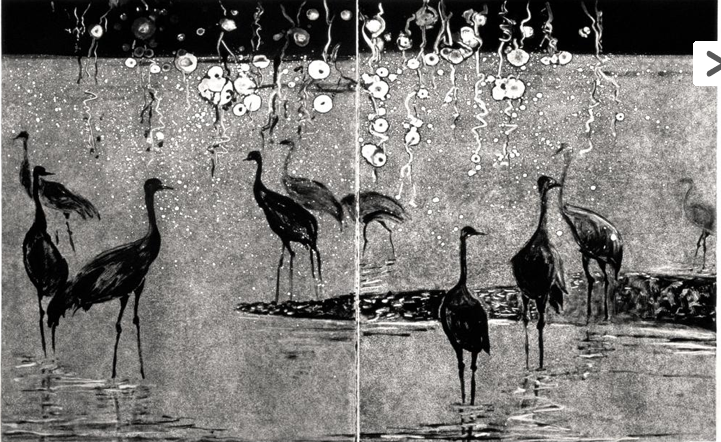
A single, cold blossom tumbles, fledged from the sky’s white branch. And the angels look on, observing what falls: all of it falls . . . Angels as observers. The afternoon lengthens, steepens, flares out— no matter for them. It is assenting that makes them angels, neither increased nor decreased by the clamorous heart: their only work to shine back, however the passing brightness hurts their eyes. Angels watching.  Saying yes.  Shining back. It is assenting that makes them angels The full text of November Angels can be found here. The photo is of a print, Blossoms Falling, by Masha Schweitzer at the Los Angeles Printmaking...

read more

November Angels?

Posted by on November 16, 2011 in Blog, Healing Poetry

November Angels?

One thing leads to another.  Three years ago I wrote about the poem, “My November Guest,” by Robert Frost.  This morning I found myself looking at the poem again.  It’s a poem in which the speaker becomes aware of sorrow as a guest and begins to understand how deeply sorrow appreciates “the desolate, deserted trees/ the faded earth, the heavy sky.” Since I first came across Frost’s poem I’ve been struck by his notion: feelings as simply guests.  Nothing more or less.  They come and they go.  A particular feeling can be absent for days or weeks or even months and then one afternoon it can simply show up, unexpectedly. The same notion is there in Paul Simon’s lyrics: “Hello darkness, my old friend.” And it’s there in Rumi’s poem: This being human is a guest house. Every morning a new arrival.   A joy, a depression, a meanness, some momentary awareness comes as an unexpected visitor. Sorrow as unexpected visitor.  Sorrow as stranger? This morning I found myself doing a simple search on hospitality toward strangers.  I found this, from Hebrews: “Do not forget to entertain strangers, for by so doing some people have entertained angels without knowing it.” And then I found this: a poem, “November Angels” by Jane Hirshfield. An interesting juxtaposition, I think.  Sorrow as stranger.  Sorrow as angel?  And what is an angel really?  Or what could it be? It’s one of those things that a person could write about.   Note: Lately, I’ve been placing my links at the bottom of my posts instead of in the middle because of something I read this past summer about the process of reading in Nicholas Carr’s book, The Shallows.  He makes a good case for the way links in the middle of things disrupt a process of deep reading and engagement and concentration.  One of these days I’ll write a bit about that here. In any case, the links for this post: My November Guest at A Healing Library The Sound of Silence lyrics by Paul Simon Rumi’s poem, The Guest House The citation from Hebrews See also: from My November...

read more

Enough: A Poem for a November Morning

Posted by on November 8, 2011 in Blog, Healing Poetry

Enough: A Poem for a November Morning

I like this poem by Jeffrey Harrison for its apparent simplicity.  For its timeliness—a warm cloudless November morning.  For its honesty—that surprise toward the end of the first stanza when the speaker of the poem admits to a mind that is not quiet but is instead roiled with personal grievance. It’s a gift, this cloudless November morning warm enough for you to walk without a jacket along your favorite path. The rhythmic shushing of your feet through fallen leaves should be enough to quiet the mind, so it surprises you when you catch yourself telling off your boss for a decade of accumulated injustices, all the things you’ve never said circling inside you. I love the way the wind picks up in this poem—and it shifts and changes everything and it’s as if the whole day is sighing its wise advice. It’s the rising wind that pulls you out of it, and you look up to see a cloud of leaves swirling in sunlight, flickering against the blue and rising above the treetops, as if the whole day were sighing, Let it go, let it go, for this moment at least, let it all go. I love the way the speaker of this poem goes on a walk and how it’s while walking that the thorny problem emerges—an entire decade of problems—but it’s also while walking that the problem is lifted up and carried on the wind. And I love that the poem is entitled “Enough.”  Enough of that personal grievance circling around and around in a loop like all our old obsessions.  And then there’s that other sense of enough that seems so right for November—that sense of plenty.  In this moment—no matter who we are and no matter what we are and no matter what we’re doing—in some very real sense that is enough. A full text of the poem, “Enough” by Jeffrey Harrison If you scroll down on this page you can read the poem as a Text Flow.  This is also available as an app–a month of free daily poems that are formatted in a Text Flow pattern (animated, with one line or word appearing at a time).  It looks like after the first month of free poems that a year of daily poetry costs three...

read more

A Conversation with the Poem, Kindness

Posted by on October 18, 2011 in Blog, Healing Poetry

A Conversation with the Poem, Kindness

Kindness by Naomi Shihab Nye Before you know what kindness really is you must lose things, feel the future dissolve in a moment like salt in a weakened broth. What you held in your hand, what you counted and carefully saved, all this must go so you know how desolate the landscape can be between the regions of kindness. How you ride and ride thinking the bus will never stop, the passengers eating maize and chicken will stare out the window forever. Oh.  I didn’t get this the first three or four or five times I read this but now I’m reading you more slowly and I’m seeing this bus ride through the landscape as a metaphor for how endless a time of desolation can feel while we’re in the middle of it.  This time I’m reading more slowly.  I see the line “between the regions of kindness” and I see the bus ride in a new way.  In hindsight we can see it’s just a bus ride—between places—the kindness will return—but in the middle of the desolate time it can seem to last forever.  Yes.  That’s so often what gets us in trouble.  That seeming. And I’m trying to think now what my own metaphor for that desolate time between might be.  I don’t know yet. Before you learn the tender gravity of kindness, you must travel where the Indian in a white poncho lies dead by the side of the road. You must see how this could be you, how he too was someone who journeyed through the night with plans and the simple breath that kept him alive. Yes, that I see.  And it’s like what Marie Howe wrote in her poem in one of my favorite books of poetry of all time, What the Living Do.  That poem about her brother who was dying and how he was trying to wake her up:  And he said, What surprises me is that you don’t / And I said, I do. And he said, What?/ And I said, Know that you’re going to die./ And he said, No, I mean know that you are. Before you know kindness as the deepest thing inside, you must know sorrow as the other deepest thing. You must wake up with sorrow. You must speak to it till your voice catches the thread of all sorrows and you see the size of the cloth. These are words that just resonate for me—till your voice catches the thread of all sorrows and you see the size of the cloth.  The size of the cloth.  I so love that.  How enormous it might be.  And how that gives a sense of perspective to each of our own threads.  I once dreamed a whale and somehow I understood that I was going to need to digest this whale one bit at a time.  So enormous.  The size of the whale.  The size of the cloth.  The size of all sorrows laid end to end and pieced together. Then it is only kindness that makes sense anymore, only kindness that ties your shoes and sends you out into the day to mail letters and purchase bread, only kindness that raises its head from the crowd of the world to say it is I you have...

read more

A Dialogue or Conversation Poem: A Prompt for Writing and Healing

Posted by on October 12, 2011 in Blog, Healing Poetry, Writing and Healing Prompts

A Dialogue or Conversation Poem: A Prompt for Writing and Healing

In a classic dialogue poem, as I understand it, you create two characters and they carry on a conversation—in poetry.  A variation on this theme—a conversation poem?—is a writing idea I’ve shared with my students.  I’ve been thinking for a while now that this existed somewhere in the world, and it probably does, but then again it’s possible I may have made it up.  In any case, the way I’m thinking about a conversation poem is you actually write your lines between the poet’s lines—in a conversation. I think the best way to begin this is to first copy the poem out, leaving spaces after every second or third or fourth line.  You could do this on paper or on a computer document.  And it could happen that as you were writing you would find yourself stopping to ask a question or to respond—and then you could put your questions and responses in the spaces between lines.  Maybe in italics?  Or indented?  And then you could begin to work your way toward some back and forth and see what happens.  It’s yet another way of responding to a poem.  Of imprinting a poem.  Of making it your own. It could look something like this, using Mary Oliver’s “Journey” as an example: One day you finally knew what you had to do, and began, though the voices around you kept shouting their bad advice — your response . . . something about those voices that are shouting, the voices you imagine and what advice they are actually shouting and what is it that makes the advice so bad or wrong.  what is precisely the wrong advice now? though the whole house began to tremble your response . . . what you see what you wonder about when you picture the whole house trembling or whatever it is you imagine when you consider that a single action you make could cause an entire house to tremble.  what’s it like to have that kind of power? and you felt the old tug at your ankles. “Mend my life!” each voice cried. But you didn’t stop. your response . . .  oh, now the voices in the poem are using actual words and they are not just asking they are demanding–they require mending.  And what does it feel like not to stop for them?  Or maybe would you?  Whose voice would cause you to stop?  Whose wouldn’t? These are just a couple ideas.  Of course you could do it differently. I’m just remembering now where I first got the idea for this.  It was when I was teaching writing at Prodigals Community, a residential recovery center.  A woman, M., wrote a poem and when I read the poem I was very taken with it and I ended up asking her a few questions about it.  She didn’t answer my questions just then, but she wrote the answers to my questions as new lines in the poem!  She inserted the new lines into the document in italics—between the old lines and shared it with me the next week. There was something so powerful about this.  Like revision happening actively on the page.  Like a conversation with me as reader happening inside the poem—or a conversation with her own self. See also Healing poetry Full...

read more