
Blog
Toni Morrison on Beowulf and Grendel: Two Very Different Kinds of Quest Stories
Evening before last, Tuesday evening, I got a chance to see, in Greensboro, a lecture by Toni Morrison, Nobel and Pulitzer Prize-winning author of Beloved and Song of Solomon, among other novels. I’d never seen her speak before. She has a wonderful—and inspiring—presence. She’s a natural storyteller—dramatic, funny, pausing in all the right places. She held the audience in her hands. And the stories she happened to tell were, interestingly enough, quest stories. She began with a brief introduction—her belief in the importance and power of story. She then proceeded to retell the ancient story of Beowulf—an epic narrative about a monster, Grendel, who ravages a Scandinavian kingdom. She told, first, the original story in which Grendel is depicted as the epitome of pure senseless evil, devouring the citizens of this kingdom for no reason other than because he can. And then a hero arises—Beowulf. This hero’s quest involves protecting the kingdom, defeating the monster. He manages, in battle, to cut off the arm of Grendel. But then the story—and the quest—becomes more complicated. Grendel, the monster, returns home to his mother and she turns out to be a yet fiercer monster—and vengeful. She launches her own attack on the kingdom, slaying large numbers of citizens and placing their bodies in her pouch. (Here Ms. Morrison added one of her nice touches, offering a memorable visual image: How wonderful, she said, how perfect, that the mother was carrying a pocketbook.) Beowulf’s quest continues. He follows the mother monster to her lair, engages her in battle, and manages to take her sword and, with this sword, cut off her head. And the blood from her body proceeds to melt the sword. The original Beowulf is a bloody quest story—the hero’s quest ends in violence and conquest. But then, as a counterpart to Beowulf, Ms. Morrison offered another story–a shift in point of view—a different kind of quest story. Drawing from John Gardner’s novel, Grendel, she offered a retelling of the story from the monster’s point of view. There’s not enough time or space here to do Gardner’s novel justice—but this is the part that I took away from Ms. Morrison’s lecture. In the retelling of the story, Grendel has an inner life—he is no longer a beast, Morrison told us. And, unlike the original story, he is capable of some degree of transformation. This transformation occurs, at least in part, via a character in the novel, Shaper, who is a poet. And, she suggested, it is through language—the comprehension and use of language (rather than his former bestial sounds)—that Grendel is transformed. This second story offers a very different kind of quest—a quest that Arthur Frank might call a post-modern quest—a quest that has to do with inner transformation rather than with conquering. Ms. Morrison suggested two things near the end of her talk that separate humans from other creatures—that separate us, she said, from, for instance, asparagus. First, love—namely the ability to care for creatures that are not our own and from which we may not receive benefit. And, second, language. Ms. Morrison believes language is capable of transformation. She believes, I think, that language is capable of transforming evil. Of transforming individuals. Of transforming kingdoms. Of transforming countries. Of shifting stories from violent ones to stories in which...
read moreWriting and Healing Idea #26: Figuring Out Where One is on the Map
Imagine, for a moment, that there’s a map and imagine that there are three kinds of roads one can follow on this map. There are probably a million or so roads but say, for the sake of argument, that there are three main kinds of roads. And say that they each of the roads has a name. Maybe on your map the roads have catchier names than these—you can rename them if you like—but, nonetheless, here are three types of roads you can use as a kind of starting point: Restitution Road Chaos Cul de sac Quest Parkway Draw the roads if you like—or begin to draw them inside your mind. Then write about what the roads look like on your map. Write about which ones you’ve taken. Write about which ones you wish you could take. Write about the signs on these roads. Write about where each of the roads might lead. Write about where on the map you are right now, at this moment. (And if you’d like some company as you’re writing and imagining you can look at The Road Not Taken, Robert Frost’s preeminent poem about roads. Press play at the website page if you’d like to hear Frost himself reading the...
read moreQuest: A Word-Map from Visual Thesaurus
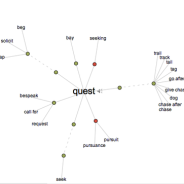
Here’s a graphic of the word QUEST, courtesy of Visual Thesaurus:
read moreThe Wounded Storyteller: A Recommended Book (Part Three of Three)—The Quest Narrative
I’m returning now (finally) to The Wounded Storyteller, and to the third and final kind of narrative Arthur Frank suggests a person can make in the wake of illness and suffering—the quest narrative. He defines this narrative thus: Quest stories meet suffering head on; they accept illness and seek to use it. He outlines a structure for this quest story, borrowing from Joseph Campbell’s Hero With a Thousand Faces. He describes three key stages of a quest, which I’m including here with a few comments. (These stages may already be quite familiar to many of you.): Departure: This begins with some kind of call. In a mythic hero or heroine story this call might be that moment when something or someone entirely new appears and sets an adventure in motion—say, for instance, a stranger appears with a rumor about a holy grail that needs to be located. In an illness story the call can be a symptom—a call from the body itself. Or it can be that moment when a doctor gives a name to the symptom. Included in this first stage is the typical response to this call—for most heroes and heroines as well as ordinary folks—“the refusal of the call.” No, this can’t be. No, I must have heard wrong. No. “Eventually,” Frank writes, “the call can no longer be refused—symptoms are unmistakable, diagnoses are made—and what Campbell calls ‘the first threshold’ is crossed.” Crossing this first threshold ushers in the second stage of the quest. Initiation: This stage involves what’s called “a road of trials”. This is the long middle part of the quest story. The part where a person may begin to reckon with the fact that this thing—this illness or loss or trouble or adventure—or all of these combined—this thing is going to be something of a big deal. This is not nothing. Something is happening. Often a significant part of this stage can be frightening and uncomfortable. The hero or heroine is tested and tempted. Like Odysseus on his ship steering between Scylla and Charbydis. A key part of this stage is a sense that at some point the hero or heroine is changed. Transformed. Something happens—not just outside the hero or heroine but inside. This is perhaps the key place where this narrative differs, for instance from the restitution narrative. X is no longer quite X. X is becoming Y. This stage of the quest story ends with what Campbell calls a boon. The teller of the story has received something—a blessing of some sort—or treasure—or piece of wisdom. And now is ready for the third stage. Return: Here the teller returns from an experience—an adventure—a road of trials—a journey—somehow marked. (Like Odysseus returning to Penelope. Or Frodo returning to the shire.) Here, Frank makes an interesting distinction. In one kind of hero story the hero returns as one who has conquered. And this conquering hero may, on return, boast of his accomplishments. In another kind of story—what he calls a postmodern kind of hero story—the hero returns not so much boastful as somewhat humbled. Frank writes: The paradigmatic [postmodern] hero is not some Hercules wrestling and slugging his way through opponents, but the Bodhisattva, the compassionate being who vows to return to earth to share her enlightenment with others. Compassion as...
read moreMary Swander’s Fifth Chair: Honoring the Chaos Narrative
Before I go ahead and finish writing about Arthur Frank’s The Wounded Storyteller, and make my way to his third kind of narrative, the quest narrative, I thought I’d put in a passage from an essay by Mary Swander, an essay that manages to convey well, I think, something of the chaos narrative—and how hard it can be sometimes to get someone to listen to, and help hold, the chaos narrative. In an essay, called “The Fifth Chair,” in the anthology, Healing Circle, that she co-edited, Mary Swander writes about her experience with myelitis, an inflammation of the spinal cord, which resulted for her in an extremely painful, chronic, relapsing, and at times immobilizing illness. At one point she finds herself requiring a wheelchair, dreading sunset because her joints had this tendency to lock up during the night, immobilizing her in her bed. And she writes about how listeners—these nearly always able-bodied listeners—had a tendency, to interrupt her story of illness, her at times perhaps chaotic story of illness, and insert their own meaning. She writes: A huge chasm opened between me and the rest of the world. I looked toward others for support and a cacophony of well-meaning voices rose up to fill the empty spaces. You’re making a joke of everything, taking this too lightly, some said. You’re making too much of a deal of this, others said. You’re not asking for enough help. You’re asking too much. . . I know what it’s like, I had gout for five days. You look good. You look like my grandma. I know what it’s like, I had the flu for five days. You must’ve done something really horrible in your past life to bring this on yourself now. You’re such a good person, why’s this happening to you? Are you depressed? I’m glad you can be so cheerful. Why don’t you move to town? Why don’t you go to New York and see your specialist? Why don’t you move to New Mexico? I love that paragraph. It sounds so—right. I think she gets it right—that’s what people do. Or that’s what they sometimes do. And Swander’s grace here, I think, is in seeing these voices as essentially well-meaning. There’s also a nice sense of comedy—juxtaposing these voices—conveying the cacophony they make. But what then? Swander writes in her essay how she turned away from these voices—took a respite. I stopped answering E-mail and the phone. I stopped playing the radio and the stereo. I let the silence fill my room. I read Thomas Merton, Aldous Huxley, Hildegard of Bingen. I read Meister Eckhart, Thomas a Kempis, and the Rule of St. Benedict. I read Walt Whitman, the Book of Job, Lao-Tzu, and Mary Baker Eddy. Whereas before, that cacophony of voices was filling up the empty space, she writes of how—instead—something new——–I let the silence fill my room. And that list of writers she chose to read. I’m not familiar with all of them, but of the ones I am familiar with, they’re writers who seem to know something about silence—and about empty space. Maybe that’s something that the chaos narrative needs—sometimes. Silence. Empty space. Having written that, it occurs to me to ask a next question: what books would you choose to carry along if you knew...
read moreChaos: An Image for Writing and Healing
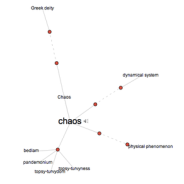
Definitions of Chaos: Any condition or place of total disorder or confusion. Often capital C. The disordered state of unformed matter and infinite space supposed by some religious cosmological views to have existed prior to the ordered universe. And, courtesy of Visual...
read more