Blog
The Wreck and the Treasure: Images for Writing and Healing
I recently came across a poem, Diving into the Wreck, by Adrienne Rich. (I found it in Staying Alive, the anthology. You can also find it here.) The poem is a quest poem—but it describes a different kind of quest, a kind of counterpoint to Lynne Cox’s Swimming to Antarctica. Not a quest across the water. But down. It begins—the first six lines—with a gathering of resources: First having read the book of myths, and loaded the camera, and checked the edge of the knife-blade, I put on the body-armor of black rubber the absurd flippers the grave and awkward mask It’s interesting to me how just typing these lines allows me to pay a kind of closer attention to the language than I do when I ordinarily read. It slows me down. Especially coming to that last line—the grave and awkward mask. So, then: a book of myths, a camera, a blade, body armor, those absurd flippers, that grave and awkward mask. These are the resources for this dive. And no companions. Not this time. The speaker of the poem announces this at the end of the first stanza: she’s not doing this with a team like Cousteau—but alone. A ladder appears. She begins to climb down. Down through layers. Down through blue, then bluer, green—then black. This is a different kind of quest. A metaphorical quest. A quest down through layers. And why keep going? In the sixth stanza, she names the reason for this particular quest: I came to explore the wreck. The words are purposes. The words are maps. I came to see the damage that was done And the treasures that prevail. The words are purposes. The words are maps. And then those lines naming two companions: the damage that was done and the treasures that prevail. It seems to me that most people I talk to about quests of one sort or another need to know two things—especially for the difficult quests—the ones that involve some exploration of wreckage, some measure of sorrow. I think we need to know that the exploration itself has some meaning—a purpose. And I think we need to know that there’s some possibility—some hope—even perhaps a promise—of treasure—jewels amid or beneath the wreckage. What Arthur Frank would call the boon of the quest. There has to be some boon. I had a writing teacher once who used to say that stories need to be bearable. One way, I think, of making stories of wreckage bearable is to figure out what the treasure is—to recognize the treasure amid the wreckage. No matter how elusive—or unexpected—no matter that the treasure doesn’t look the way we thought it would look when we finally come upon...
read moreSwimming to Antarctica: A Recommended Book
Lynne Cox, author of Swimming to Antarctica: Tales of a Long-Distance Swimmer, strikes me as a kind of ideal heroine for this month in which I’m writing about quest. There’s a kind of purity—a single-mindedness—to her narrative that has a certain appeal. She’s one of those rare people who discovered her own personal quest—her purpose in life—at the age of nine. And then she had the good fortune, and the good sense, and the persistence, to be able to carry this out. One summer morning, as she tells it, and when she was only nine years old, she found herself in an icy-cold swimming pool in Manchester, New Hampshire, swimming laps in the middle of a storm. She was there by choice. All the other swimmers in her club had begged the coach to get out of the water, leaping at his alternative proposal of two hours of calisthenics in the locker room. This was a serious swim club. Those children who had fled the cold water for the locker room could look forward to upwards of 500 sit-ups, 200 push-ups, and 500 leg extensions. Lynne Cox stayed in the water. When it began to hail, she stopped her laps and crouched in a corner next to the steps and covered her face with her hands. When the hail changed over to heavy rain she went back to swimming laps, entirely alone in the pool, hailstones floating around her in what she describes as a “giant bowl of icy tapioca.” She wasn’t one of the fastest swimmers on the team. She was, by her own description, chubby, and because she was slower than many of the others, she rarely got a chance to pause at the wall of the pool for breaks the way the others did. What she had was endurance. And a love of the water that was nothing short of extreme. She was nine years old, swimming through ice-water that everyone else had fled, and, rather than being frightened of the storm, she was exhilarated by it: The pool was no longer a flat, boring rectangle of blue; it was now a place of constant change. . . . That day, I realized that nature was strong, beautiful, dramatic, and wonderful, and being out in the water during that storm made me feel somehow a part of it, somehow connected to it. A Mrs. Milligan saw the tail end of this three-hour swim from her car in the parking lot. She was the mother of another girl on the team, a fast girl who had already qualified for nationals. When Lynne Cox finally climbed out of the pool, Mrs. Milligan met her with a large towel. She rubbed Lynne’s back with the towel, at the same time speaking into her ear: “Someday, Lynne, you’re going to swim across the English Channel.” Lynne Cox did swim across the English Channel. A mere six years later, when she was only fifteen, she set a world record, swimming the channel in nine hours and fifty-seven minutes. A few years later she swam across the Cook Strait in New Zealand. Not long after, she became the first person in the world to swim the Strait of Magellan, a body of water between the tip of Chile and the island of...
read moreWriting and Healing Idea #28: Consulting with the Wizard of Oz
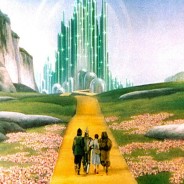
I had a dream the other night that a patient came to me and she asked me if I thought that it would be a good idea to bring her illness to the Wizard of Oz and ask him what to do. Inside the dream I thought about it for a while, and then I said, yes, I do think that’s a good idea, but I need you to tell me more about what that would be like for you. What would it be like? Say, that you were the one caught up in the tornado, landing in an entirely new and strange place, and you told a good witch in a lovely dress that you had just been diagnosed with an illness—or another problem had befallen you—stress—loss—some new and thorny problem—or an old and thorny problem—any one of these will do—and say that you told her that what you really wanted was to get back home (as if maybe you suspected that if you only got home you could deal with this—you could figure out what to do next) and the good witch said, well, the smartest one in these parts is the wizard—and I would suggest you follow this road here. . . What would happen next? (And, let’s say, for the sake of the argument, that if this were an illness of some sort you’d already done the usual things—consulted a doctor, seen a specialist perhaps, started some sort of treatment. Say that you were looking for a little more help—not so much with medical care at this point but with the process of healing—figuring out what else you could do, in addition to medical treatment, that might augment the healing inside your body, that might make a difference. As if medical treatment were only the beginning of the quest—say, the crossing of the first threshold—and not its end.) What might the road be like on the way? Would there be helpers? Someone as kind and bumbly as that scarecrow? As innocent as the tin man? And say you made it to the Emerald City? What would you find when you got there? What would you ask? (Would you want to ask something about purpose? Your quest? Your next task? Or maybe just something about getting back home?) What would you hear in response? And then what would happen next? Photo from Telegraph–where photo is sourced from the Everett...
read moreWriting Exercise #27: What Am I Here For (Part 2 of 2)
If you haven’t already looked at the first part of the exercise you can find it here. This second part of the exercise, presented below, will lead you to fill in the third and fourth rectangles on the sheet of paper—and then invite you to take a next step—and perhaps a next one. At the top of the third rectangle write: WHAT’S IMPORTANT TO ME Here you list any and all things that are important to you, moving again, if you like between the concrete and the more abstract. In the final rectangle you write: WHAT I FEEL I MUST DO BEFORE I DIE I’ve seen people write everything in this rectangle from visiting a certain country to reconciling with a particular person to finally getting their hair right. Make this list as long or as short as you like. When you’ve finished filling in the four rectangles, take out another sheet of paper and fold it into four rectangles like before. On this new sheet of paper you are going to record four images, one in each rectangle, each image corresponding to one of your lists. In order to discover these images, you may want to give yourself a block of uninterrupted and quiet time—say, twenty to thirty minutes if possible. Then, beginning with the first list—What Do I Like? / What Do I Love?—read the list, either silently or aloud, over and over, noticing what image begins to arise from the list. This image can be anything that you can see or hear or touch. It can be a shape or an object—a color—an activity—a creature—a person—a vegetable—anything that seems to fit somehow with the list that you’ve created. The idea is to find a single image that resonates with the entire list. If you find it difficult to choose one best image—just pick an image—any image that appeals—knowing that you can always come back and change the image—revise it—amend it—if you want to later. You can write a word for this image—or you can draw it. Either. Then move on and do the same with the second list, and the third, and the fourth. You can, if you like, do this over a period of days. When you finish you will have a piece of paper with four images that can all be considered aspects or facets of your purpose. You can carry these four images around with you—in your pocket—or in your pocketbook—or in the back of your mind. You can hold them lightly. It may happen that the four images seem to want to come together into a single image. If so, you can draw or write this single image at the center of a new sheet of paper. When you finish you will have a single image or a series of images—either. This image—or series of images—can become, if you like, a kind of touchstone. It can become your own North Star. It can become something you write about now and then—or something you hold in the back of your mind. It can become something you can steer by when it seems like the wind is blowing this way and...
read moreWriting Exercise #27: What Am I Here For? (Part 1 of 2)
When I trained in healing imagery in San Rafael, with the Academy for Guided Imagery, I learned, on the last day of my training, an imagery exercise that can be used for the discovery of deep purpose. To be honest, when we were first introduced to the exercise, I, along with a friend who I was there with, thought the exercise seemed, well—almost silly. Too simple to be useful, I thought. Or too something. I was wrong. This exercise, which we proceeded to practice in small groups, proved to be surprisingly powerful. Since then, I’ve introduced this exercise to a number of patients. And I’ve begun to see that, at least some of the time, this exercise can point a person toward something. It has the potential to get at something deeper than short-term goals, deeper than the job at which we work, deeper than any salary or accolades we might receive for that work. It has the potential to move a person toward certain core kinds of questions—questions particularly relevant if and when a person finds themselves facing a life-threatening or life-altering illness, or when a person finds themselves facing a life-altering loss. (And one of the things an examination of these questions can do, I’ve noticed, is help a person feel calmer and more at peace—get a glimpse of the bigger picture as it were—and this itself can mitigate a stress response and, in the process, augment healing. Lawrence LeShan, who has been called the father of mind-body medicine, proposes in his book, Cancer As a Turning Point, that getting in touch with one’s purpose—or what he calls zest—can have a significant and salutary effect on the immune and healing system.) What really matters? What will matter when it’s all said and done? I attended a Jesuit college. One of my professors at that college, Father Nesbitt, a Jesuit priest and a the teacher of my first theology class as a freshman, once told us that the question to ask ourselves when we wake in the morning and first look in the mirror to wash our face is this: What am I here for? This is an exercise that looks at that question. So—the exercise, which I’ve translated into a writing exercise: You begin by folding a plain piece of paper in half and then half again, so that when you re-open the piece of paper you have four rectangles. At the top of the first rectangle you write the first heading: WHAT I LIKE/ WHAT I LOVE Then beneath this heading you make a list of all the things that you like and love. These can be small things or big things. Chocolate? Rain? The color periwinkle? At the top of the second rectangle you write the second heading: GIFTS AND TALENTS Here you make a list of all those things that you happen to be good at. These can be concrete things like fixing cars or gardening. These can also include more abstract things like kindness or listening or seeing patterns. [to be...
read moreThe North Star and A Small Beautiful Boat: Images for Writing and Healing
In her book, Reviving Ophelia, which recounts many of her own experiences in counseling adolescent girls, Mary Pipher tells about how she uses the North Star as a metaphor with the girls who come to her. She writes: I tell clients, ‘You are in a boat that is being tossed around by the winds of the world. The voices of your parents, your teachers, your friends, and the media can blow you east, then west, then back again. To stay on course you must follow your own North Star, your sense of who you truly are. Only by orienting north can you chart a course and maintain it. . .’ Even in the Midwest, where we have no large lakes, many girls have sailed. And particularly in the Midwest, girls love images of the sea. They like the images of stars, sky, roaring waters and themselves in a small, beautiful boat. I like these images too—the sky, the stars, the water, that small beautiful boat. I was trying to think of a poem that might resonate with these images and I remembered a song by Mary Chapin Carpenter—Jubilee, a song she wrote herself and which appears on her CD, Stones in the Road. Here are four lines from the song, : And I can tell by the way you’re searching, for something you can’t even name / That you haven’t been able to come to the table, simply glad that you came / When you feel like this try to imagine that we’re all like frail boats on the sea / Just scanning the night for that great guiding light announcing the jubilee. I like the images in her lyrics. The words she chooses. Frail, for instance. That sense that the boats are frail–or sometimes frail. The sense she offers of all the other boats out there on the water. And that image of what the star might be pointing toward. (When I first heard this song, several years ago, I had a vague notion of what a Jubilee might be, but then I looked it up and there was more to it than I thought. According to the Hebrew Bible, a Jubilee year occurred every fifty years and, apparently, during this year, land was returned to original owners, debts were forgiven, and indentured servants were emancipated.) A person could, I suppose, imagine healing as a quest made by water rather than by land. One could imagine traveling in a small and beautiful boat. And then there would be that star in the sky, brighter than all of the others, and holding steady, no matter which way the wind was blowing. One could imagine, if one wanted, that the star has a particular name. And that it’s pointing toward something....
read more