Blog
Writing and Healing Idea #13: Making a List of Lifelines
I wrote a few days back about having a few lifelines in place if and when you decide to do any writing about breaking. You can now, if you want, and if you haven’t already done so, formalize that. You can make a list of your own personal lifelines. Here are some questions that might help you in putting together your own list: Are there places you can go when you feel like something is falling apart? Are there places where you’ve been in the past that are safe and comforting? Can you imagine these places when you need to? Are there resources that make you feel safe and nurtured? Certain foods? Certain objects? Photographs? Poems? Letters? Books? Particular songs? Particular music? Is there someone you can call when you feel like something is falling apart? A friend? A counselor? Is there someone you can call to mind? (This can be a person, living or dead, who you know well—or perhaps someone you have never met.) Is there something or someone or even some words that you can remember—and call to mind—when you feel like something is falling apart? Make your list as short or as long as you like. Save your...
read moreA Word of Caution about Writing and Healing
Some of the writing ideas I’ve put up on this site have to do with writing about difficult or painful experiences. Though research has shown that this kind of writing can, over the long haul, be healing, research has also shown that, in the immediate aftermath, writing of this sort can sometimes feel painful. On his website, James Pennebaker, one of the chief researchers in the field of writing and health, offers this advice, which applies in particular to writing that deals with upsetting experiences: Many people report that after writing, they sometimes feel somewhat sad or depressed. Like seeing a sad movie, this typically goes away in a couple of hours. If you find that you are getting extremely upset about a writing topic, simply stop writing or change topics. I think this is sound advice. Some people may wonder: how upset is too upset? For me, an analogy to yoga is sometimes helpful here. I once had a yoga teacher tell us that when working on a new pose it’s prudent to stretch just a bit beyond where one has been before—stretching into that “good” and bearable kind of soreness—and holding that stretch for ten seconds, fifteen seconds, twenty seconds—but not stretching into frank pain. Stretching that is too painful can cause a kind of rebound effect: it hurts so much the next day that you may never want to go back to the class or ever think about yoga again. Writing can be like that. Writing that becomes too painful can make us want to shy away from the process. So, just a bit of a stretch—a bearable stretch. I also think it’s helpful to remember lifelines—those things that reconnect us to a sense of safety and comfort and belonging. And then we can call on those lifelines when we need them—when we, for instance, stretch ourselves a little farther than we intended to stretch. A healing place can be a lifeline. A healing resource can be a lifeline. Healing language. A friend. A counselor. A doctor. A teacher. A nurse. . . . Perhaps one of the most important things to know about healing grief–whether one is writing or not–is to recognize when one has become overwhelmed by grief–when the feelings have become too much–and then to ask for help. And not to hesitate to ask for this help from a health...
read moreWriting and Healing Idea #12
YOU ARE INVITED What: To let something fall apart Where: In a healing place You can start small. You can wait until you are ready. You can wait until it is the right time. You can choose one small thing in your life that has already fallen apart. You can choose one concrete thing—a favorite sweater, a cracked coffee mug. You can choose something larger. Your car. Your roof. Your marriage. Your heart. You can choose anything at all. You can write the words FALLING APART at the top of the page. Or write BREAKING. Or write BROKEN. Then begin. Write physical and concrete detail. Exaggerate. Exaggeration can be a way to make the falling apart more vivid. It can also be a way to get at a kind of truth. Write verbs. Break. Fracture. Collapse. Disintegrate. Crumble. Write sensory details. Write how the breaking feels. Write how it feels in your body. Write where you feel it in your body. If at any point this becomes too uncomfortable, take a respite. Step outside if you can. Look at the sky. Remember that at any moment you can, if you like, return to a healing place—in the actual world or in your...
read moreA Look at the Word Breaking
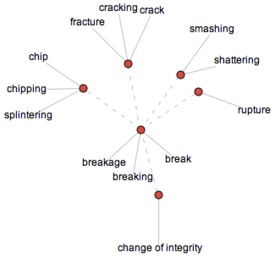
This graphic of synonyms for BREAKING is from Visual Thesaurus:
read moreNovember Index
(in chronological order) A Look at the Word Breaking Writing and Healing Idea #12: An Invitation to Write About Falling Apart A Word of Caution About Writing and Healing Writing and Healing Idea #13: Making a List of Lifelines On Holding that Which is Breaking in the Light What About the Research on Writing and Falling Apart? Writing and Healing Idea #14: Considering a Package When Things Fall Apart: A Recommended Book About Grief: What Chekhov's Cab-Driver Needs to Say Broken Vessels: A Recommended Book Writing and Healing Idea #15: Listing What Remains On Gratitude and Embracing What Remains Pensieve: An Image for Writing and Healing Four Chambers for Tyler David Tandeski: A Featured Piece On Reading "Four Chambers for Tyler David...
read moreWriting and Healing and Sweets
The first time I went to a Bar Mitzvah I loved the part where someone—the rabbi?—scattered candy across the steps at the front of the temple and the children were invited to come forward and retrieve it. The rabbi explained something about making a connection for the children—between Torah and sweetness. Not just telling them the Torah is sweet, but letting them experience the connection: reading the Torah and tasting sweetness. This week I looked this up (Google: Torah child sweet) and found a piece written by a Rabbi Levi Cooper. He explains a tradition in hassidic communities of initiating children into the study of Torah at a very young age—at the age of three—and doing so with a cookie. The teacher offers the child a cookie in the shape of the Hebrew letter, aleph. When the child can correctly identify the letter the cookie is dipped in honey and the child gets to eat the cookie. “Thus,” Rabbi Cooper writes, “we bless our children that their Torah study should always be as sweet as honey.” Wikipedia adds this: This is not just to show the child that learning is “sweet”, nor that Torah study is “sweet”, but also, to learn the sweetness of the Hebrew language. I love that—to learn the sweetness of the language. In my last year of college I managed to schedule my classes so that on Thursdays I had only one class—an eight o’clock. I loved Thursdays. As soon as class was over, at 9:15, I walked out of the classroom, across campus, and down Rockhill Road to the Alameda Plaza. This was in Kansas City, Missouri. The Plaza was, and still is now, this lovely outdoor shopping square with restaurants and shops. Back then there was a restaurant there which was called, simply, The Place. I’d go to The Place on Thursday mornings and I’d order the same breakfast each time. A poached egg. An English muffin. Strawberries with cream. A mug of coffee. The strawberries came in a blue bowl. The coffee was strong and hot. The cream was real. I ate and I wrote. For me, it was the beginning of falling in love with writing. And this falling in love with writing was all of one piece with the egg and the strawberries and the blue bowl that the strawberries came in and the strong coffee, the real cream. A strawberry can be a sweet. A chocolate can be a sweet. A good cup of coffee. A hot cup of tea. A new mug. A blue bowl. A good pen. Pat Schneider, a woman who has taught writing workshops for some twenty-five years, has written a very good and useful book about writing called Writing Alone and with Others. In a chapter on discipline, she suggests that the discipline of writing does not arise best out of obligation but will always arise best out of love. p. 51. “Rather,” she says, “than thinking of going to your writing desk as the ‘ought’ and ‘should’ work of your life, think of it as a longed-for pleasure, as a hot fudge sundae, as that which pleases you, delights you, that which you love” Yes, I agree. Though, for me at least, I sometimes find it’s easier for me to think of writing...
read more