Blog
Tim O’Brien’s “How to Tell a True War Story”: A Radical Revision
When I think about revision—when it comes to writing or healing—I tend to think about it in radical ways. I’m not thinking so much here about rereading a paper or a story and fixing a few grammar or spelling mistakes. Those kinds of surface changes are important in late stages of the writing process, but I tend to think of those kinds of changes as editing or proofreading. When I think about revision I think of something that goes beneath the surface—and nearer to the root. Looking again—and seeing something that one has never seen before. Looking again—and seeing where the gaps are—- Looking again—and changing the plot. The story that comes to mind when I think about this kind of radical revision is Tim O’Brien’s “How to Tell a True War Story,” in his incomparable collection, The Things They Carried. This is one of those stories better read in its entirety than described, but here is an excerpt to give some sense of it if you’ve not before come across it: In any war story, but especially a true one, it’s difficult to separate what happened from what seemed to happen. What seems to happen becomes its own happening and has to be told that way. The angles of vision are skewed. When a booby trap explodes, you close your eyes and duck and float outside yourself. When a guy dies, like Curt Lemon, you look away and then back for a moment and then look away again. The pictures get jumbled; you tend to miss a lot. And then afterward, when you go to tell about it, there is always that surreal seemingness, which makes the story seem untrue, but which in fact represents the hard and exact truth as it seemed. The story is, at one level, about the death of Curt Lemon. It’s a story about a soldier, home from the war, trying to tell, among other things, about the death of his friend, Curt Lemon. The story is told in fragments—pieces—and at the center is Curt Lemon stepping on a booby-trapped 105 round and the explosion blowing him up into a tree. Curt Lemon’s best friend, Rat Kiley, another soldier, goes mad with grief, after. He shoots at a baby water buffalo in his grief. Over and over. And then he writes Curt Lemon’s sister and he tells her that Curt Lemon was a tremendous human being, that he loved him, the guy was his best friend in the world, his soulmate. And the sister never writes back. The story continues. The speaker of the story is home from the war, he’s telling the story, it’s twenty years later, he’s still telling this story, and then he’s telling what it’s like to try and tell it—and that too is all part of the story: Now and then, when I tell this story, someone will come up afterward and say she liked it. It’s always a woman. Usually it’s an older woman of a kindly temperament and humane politics. She’ll explain that as a rule she hates war stories; she can’t understand why people want to wallow in all the blood and gore. But this one she liked. The poor baby buffalo, it made her sad. Sometimes, even, there are little tears. What I should...
read moreWriting and Healing Idea #39: Changing the Plot
This idea springs out of the previous post and from E.M. Forster’s distinction between story and plot. Story: The king dies and then the queen dies. Plot: The king dies, and then the queen dies of grief. You can begin by choosing five moments—from your life—from someone else’s life—or you can make them up. Or you can, if you like, write about the king and the queen. Draw the moments as plot points on a piece of paper. For instance: • THE KING DIES. • THE QUEEN DIES. Then, begin to play with connecting the points—and reconnecting them—in new ways. Write about the connections. Write different plots. Different ways that the dots get connected. If possible, make the plot mildly ludicrous, improbable—this itself a way of stretching the mind to imagine new possibilities. Write new points. Here, for instance, is one way—an alternative way—of connecting the two plot points about the king and the queen. • The king dies. • The queen dies, under mysterious circumstances. • The prince, their son, wants to believe his mother died of grief. (It’s so much harder to accept, sometimes, that death—it just happens—accidents and illness—mysteries—-) • The queen returns in her next life as a fish. • The prince meets this fish one day when he’s out on a boat and she jumps up out of the water next to his boat. • The fish speaks. • And she tells him—– What? What does she tell...
read moreSo What is Revision? And Why Might it Be Important to Writing and Healing?
Here, by way of beginning, are 10 synonyms for the word revision, all found in my desktop thesaurus: Reconsideration Review Reexamination Reassessment Reevaluation Reappraisal Rethink Change Alteration Modification When I look at the list I see a pattern: Reconsideration Review Reexamination Reassessment Reevaluation Reappraisal Rethink Change Alteration Modification From looking again to reappraisal to rethinking—to transformation. This, I think, is what can come, ultimately, out of the process of revision: transformation–a literal change in form. And it has always seemed to me that going through this revision process in writing—and perhaps going through it over and over again—can point to what’s possible in healing. One can look again—at the body itself—at an illness—at a loss—at a particular moment from one’s life. One can see what one perhaps couldn’t see when one was smack in the middle of it. One can, perhaps, see the value of something in a new way. And then—-something can change—– The facts themselves may not change—they usually don’t. What changes, I think, is the way the facts get put together—and the meaning that gets attached to those facts. E.M. Forster, in his book, Aspects of the Novel, describes the difference between a story and a plot. A story: “The king died and then the queen died.” A plot: “The king died, and then the queen died of grief.” The facts don’t change in the second rendition. The king and queen still die. Those points—those events—remain unchanged. But the dots are now connected in a particular way. A particular meaning is attached. A theory. A hypothesis. (I mean no one but the queen really knows for sure, right? And she might not even know.) Maybe that’s one of the key things that changes when we practice revision, and maybe that’s what makes the practice of revision especially important to healing: we can reconsider the plot. And we can change...
read moreNine Images for Writing as Healing
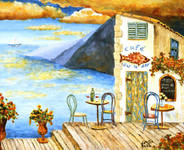
Writing as a clean well-lighted place. A cafe that is always open. Writing as a pumpkin–that sense of possibility. Writing as a broom–sweeping out the guest house that is the self. Writing as a map to a healing quest. Writing as a pensieve–a container in which to spot patterns and links. Writing as a small beautiful boat–a vehicle for a healing quest. Writing as a way to remember the sky. Writing as a Refuge. Writing as an unwinding ball of string. [Please note that the sources and links for the above graphics are the following: The cafe painting is by Linda Paul. The pumpkin photo is my own. The broom photo is from a site called shelterrific. The map image, is from Wikipedia. The pensieve is from the Harry Potter Lexicon. The sailboat photo is from 72 Seconds. The wild geese photo is found here. The cottage painting is by Thomas Kinkade. And the string photo can be found here, where you can also learn how to measure the distance to faraway...
read moreFishing: An Image for Writing and Healing
The following passage, from Peter Elbow’s Writing Without Teachers, resonates nicely with the image that Michelle Huneven uses for conversation in her novel, Jamesland. There she writes about conversation as an unwinding ball of string. Here, the string is cast out onto the water: Elbow writes [p. 77]: Writing is a string you send out to connect yourself with other consciousnesses, but usually you never have the opportunity to feel anything at the other end. How can you tell whether you’ve got a fish if the line is always slack? The teacherless writing class tries to remedy this situation. It tries to take you out of darkness and silence. It is a class of seven to twelve people. It meets at least once a week. Everyone reads everyone else’s writing. Everyone tries to give each writer a sense of how his words were experienced. The goal is for the writer to come as close as possible to being able to see and experience his own words through seven or more people. That’s all. To improve your writing you don’t need advice about what changes to make; you don’t need theories of what is good and bad writing. You need movies of people’s minds while they read your words. This is, I think, a terribly interesting notion—that what we may really want—at least some of the time—when we put words out there—is not evaluation—or approval—or even agreement—but this something else—this other thing–—this kind of movie of someone else’s mind—a movie of another consciousness receiving the words. Would this be the fish then? The fish caught? And this as one way out of darkness and silence? And, at the same time, a way to make writing clearer and stronger and more meaningful? Well, I’m all for...
read moreHow to Find a Good Writing Group
First—-a good writing group is hard to find. Even a good group of two. It is harder to find than a good grocery store, or a good bakery, and probably harder than finding a good yoga class. Finding a good writing group is probably more on a par with finding a great job—or the right house. Now and then a fabulous house or job lands in your lap. But more often this is the kind of thing you have to prepare for, and search for, and be willing to invest some time in. How to prepare? A few words of advice (to be used as you wish): If and when you feel like a writing group is something you’d like to explore, and, assuming the fabulous writing group or workshop has not already landed in your lap, I’d recommend reading Peter Elbow’s Writing without Teachers and/or Pat Schneider’s Writing Alone and with Others. The two books complement each other well. Elbow’s book is the older of the two. It was first published in 1973 and is a classic in the field of teaching writing. Two chapters—“The Teacherless Writing Class,” and “Thoughts on the Teacherless Writing Class”—are good preparation for both recognizing a good writing group when you come across one, or, perhaps, starting a new one of your own. Elbow’s emphasis is on the importance of getting honest authentic feedback from readers—and how this process of feedback can grow one’s writing. Schneider’s book, published in 2003, is the newer book. It’s a longer book than Elbow’s, chattier, with more stories and examples drawn from her classes. One of its particular strengths is in its advice on how to recognize and help create a healthy workshop. And Ms. Schneider offers this advice [p. 199] on recognizing a good writing class: After being with your teacher, do you feel more like writing or less like writing? You should never be made to feel embarrassment or shame in the classroom. If that happens, there is something wrong with the way writing is being taught. Drop the class. Take auto mechanics or geometry! Then write about fixing cars, or about the perfect problem. It’s the right question I think: After being with your teacher do you feel more like writing or less like writing? It’s the kind of question one could ask about a writing teacher or a writing class or a writing group or perhaps anything that one seeks out in order to foster one’s writing. After being with __________, do you feel more like writing or less like...
read more