Blog
A Research Study on the Health Benefits of Writing About Goals
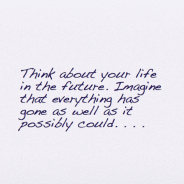
In 2001, Laura King, one of the researchers in the field of writing and health, conducted a study in which she looked at what happened when college students wrote about something she calls “their best possible future self.” By this time, a large amount of data had already been collected on the benefits of writing to work through difficult past experiences. King became interested in exploring what other kinds of writing might be beneficial to health. Her study is one that I don’t think has been written about enough. She looked at 81 undergraduate students, randomly dividing them into four groups: a group which wrote about their most traumatic life event; a group which wrote about a best possible future self; a group which was asked to write about both; and a group which wrote about a non-emotional or control topic. Each group wrote for 20 minutes a day for 4 consecutive days. Those students selected to write about a best possible future self were instructed to write in response to this prompt: Think about your life in the future. Imagine that everything has gone as well as it possibly could. You have worked hard and succeeded at accomplishing all of your life goals. Think of this as the realization of all your life dreams. Now, write about what you imagined. A couple of interesting results came out of this study. First, when students were tested three weeks after writing, it was found that writing about a best possible self was significantly less upsetting than writing about a traumatic life event. Second, the distress of writing about a traumatic life event was short-term. It had dissipated by five months. Third, both kinds of writing were beneficial. That is, when students were studied five months after writing, those students who wrote about a traumatic life event, those students who wrote about a best possible self, and those students who wrote about both—all of them experienced a decrease in illness. Only those students who wrote about a non-emotional topic showed no change. The study is published in the July 2001 issue of Personality and Social Psychology Bulletin. In her discussion, King draws the following conclusion: The act of writing down our deepest thoughts and feelings is key to the benefits of writing. However, and importantly, the contents of our deepest thoughts and feelings need not be traumatic or negative. Quite the contrary, examining the most hopeful aspects of our lives through writing—our best imagined futures, our ‘most cherished self-wishes’—might also bestow on us the benefits of writing that have been long assumed to be tied only to our traumatic histories. I think this an enormously interesting and useful study. What I do not think is that this study should be used as a reason to counsel anyone and everyone to “move forward” to “think about the future” and “let go of the past.” Rather, I think what this study does is offer evidence that both are fruitful. Looking back toward unfinished business in the past is fruitful. Looking forward to a possible future is fruitful. And it seems reasonable to conjecture that in the best possible circumstances, each person would be permitted to choose for themselves—perhaps at times with some guidance—when to look back—and when it might be time to look...
read moreWriting and Healing Idea #43: Imagining the Future
Imagine for a moment that you’ve been handed a ticket. And imagine that this ticket grants you admittance aboard a vehicle which can then carry you to any point in your future that you desire. Six months from now? One year? Five years? The vehicle is navigated by a kind and skilled conductor. You simply need to tell him to which period of time you would like to travel. Then close your eyes. And let yourself begin to go there. Imagine that upon your arrival at this moment in the future, you discover that everything has gone as well for you as it possibly could. Imagine that things have gone the way that in your deepest heart you have most wished for them to go. Imagine the details. You may find that a particular scene emerges in your mind’s eye. Notice yourself in this scene. What are you doing? Who and/or what is around you? What does a typical day look like? What else do you notice? And what...
read moreOne Year of Writing and Healing: A Retrospective: Nine Metaphors
Well, I took some of my own advice and made a clean copy of some pages from my site. What I ended up doing was printing out the pages under the category of Healing Images. The first surprise—more pages there than I realized—it printed out to 38 pages—which makes me wonder if the site isn’t getting a bit too bulky. Not sure what to do with that observation yet. So what I decided to do instead is attend to those images that seem now to resonate. And when I did, what emerged was nine images—nine images which could also, I suppose, be called metaphors. Nine Metaphors for Writing as Healing Each offered with a link to its post—and to some of the poems that were a source of these images: A CLEAN WELL-LIGHTED PLACE Writing as a café. Or as any clean well-lighted place that stays open and is there when you need it. In the story by Hemingway, an old man sits on the terrace of a café at closing time. It is late, but the old man, the last customer of the night, is reluctant to leave. A young waiter wipes off the old man’s table with a towel and tries to shoo him out. But a second waiter, older than the first, understands the old man’s need to linger. “Each night,” he says, “I am reluctant to close up because there may be some one who needs the café.” A PUMPKIN Writing offering a sense of possibility. Like the pumpkin in Cinderella. That moment in the story when all seems lost—the stepsisters have torn Cinderella’s dress, they’ve gone on to the ball without her. Cinderella’s heart is breaking. And then the godmother comes. The pumpkin becomes a carriage. It maintains the lines and shape of a pumpkin, but now it has wheels—and a door. Cinderella climbs inside. The carriage begins to move. . . . Something there—that moment. The godmother comes. The pumpkin becomes a carriage. Writing is like that—or it can be like that—that possibility of transformation—the pumpkin becoming a carriage—and the carriage beginning to move— A BROOM Writing as a way to sweep out the guest house that is the self. From the poem by Rumi. The Guest House. If being human is a kind of guest house, and if every morning we can expect a new arrival—including, sometimes, those more difficult guests—sorrow and so forth—and if those guests are capable of sweeping out the house of the self—preparing us—for something (who knows what?)—then maybe, just maybe, writing can facilitate all of this. A way to name the visitors and help them sweep. Writing as a broom. A MAP Writing as a kind of map to the healing quest. It’s there in Adrienne Rich’s poem. Diving into the Wreck. “The words are maps.” First, you gather the resources you’ll need for your quest. In this particular poem, this involves a book of myths, a camera, flippers, a mask. A ladder appears and you begin to climb down. To explore the wreck or to search for treasure—or both. Writing offers the map. A way perhaps to keep track of where you’re going—or where you’ve been—or where you’d like to be going. “I came to see the damage that was done/ And the treasures that prevail.”...
read moreI write because. . .
For me, part of the process of revision—in this case, looking again at One Year of Writing and Healing—has been going back to the basics and beginning (again) to ask myself some very basic questions: Now, why again am I doing this site? What have I done so far? What do I want it to become? What might I want a second year of writing and healing to look like? And, in the middle of this process, I was inspired by Sharon Bray to ask an even more basic question: Why do I write? Her question inspired me to do a search on “I write because. . .” and then to make a page of quotes of writers who have responded to that question. I made the page and brought it into a writing workshop at Cancer Services that is just forming, and I can tell you that the words carry even more resonance when read aloud. That’s what we did. We just went around the circle and took turns reading the lines aloud: I write because. . . It was a bit like reading poetry aloud. For me the words became more powerful and clearer as I heard them read. They became more alive. Hearing them aloud—particularly in different voices—it became easier to hear which lines carried a particular resonance–which lines struck a chord. Here are the lines we read. (Can you hear us reading them?): I am going to write because I cannot help it. —Charlotte Bronte I write only because There is a voice within me That will not be still. —-Sylvia Plath I write entirely to find out what I’m thinking, what I’m looking at, what I see and what it means, what I want, and what I fear. —-Joan Didion I write because I want more than one life. —Anne Tyler I write because it gives me the greatest possible artistic pleasure to write. —Oscar Wilde I write because I don’t know what I think until I read what I say. —Flannery O’Connor And, from Orhan Pamuk’s Nobel Prize acceptance speech: I write because I have an innate need to write. I write because I want to read books like the ones I write. I write because I love sitting in a room all day writing. I write because I want others, the whole world, to know what sort of life we lived, and continue to live, in Istanbul, in Turkey. I write because I love the smell of paper, pen, and ink. I write because it is a habit, a passion. I write because I am afraid of being forgotten. I write to be alone. I write because I like to be read. I write because once I have begun a novel, an essay, a page I want to finish it. I write because it is exciting to turn all life’s beauties and riches into words. I write to be...
read moreSpeak the Language of Healing: A Book for Making Peace with the Body When the Body Has Cancer
Writing earlier this week about making peace with the body prompted me to pull out a book that I haven’t looked at in a while. Speak the Language of Healing: Living with Breast Cancer without Going to War. It’s an intriguing title. An intriguing book. And one I was introduced to a few years ago now by a patient, Norah, who found the book during a time when she was trying to figure out how to live with metastatic breast cancer. I’d known Norah two years before she got her diagnosis of cancer. She was a patient of mine, had seen me on and off for some stress-related symptoms and had been doing quite well. She’d suffered an enormous amount of pain in her early life, and she’d found a way to work through some of her grief about that time, and she’d begun to feel a sense of freedom—and possibility. She was preparing to move away from North Carolina and take a new job in a large city. She was excited about the move. She’d just made a trip to look at housing. And then one evening, not long after she’d made this trip to look at her new city, she came in to see me, and she was carrying a large brown grocery bag. She sat down, and she proceeded to take from the bag a bottle of wine—and then two glasses. And she handed one of the glasses to me. This was entirely unlike anything she’d ever done. In fact I can’t say I’ve ever had a patient bring wine and glasses to an appointment—not before or since. She opened the wine. She asked me if I’d take some. Sure, I told her. Sure. She poured a bit of wine in my glass, and then a bit more in hers. I waited. And then I asked. What are we toasting? To breast cancer, she said. I’ve just been diagnosed with breast cancer. And so we toasted breast cancer. She’d found a lump. She’d been in to see her internist a month before and at that time everything—her exam—including her breast exam—all was normal. And then she’d found this lump. And she’d gone in for an evaluation—a biopsy—the lump was cancerous. Sometimes patients go through a phase of denial where they believe a serious condition is not going to affect their lives. And, sometimes, it would seem that physicians go through this. In this particular case, I was the one who stayed in denial for a bit. I thought—she’s doing so well, she’s just taken this new job, she’s excited, she has a breast tumor, she’ll get treatment, maybe it will delay her move, she’ll still get to go. Norah suspected it was going to be a bigger deal. Norah was right. Further evaluation revealed that she had disease in her liver and her bones. Stage four disease. She changed her plans. She began chemotherapy. And as she went through her treatment—and her illness—and all the changes that this brought—and as she began to write about some of this, well, Speak the Language of Healing was the kind of book that she needed to find. The book is authored by four women—Susan Kuner, Carol Matzkin Orsborn, Linda Quigley, and Karen Leigh Stroup. Each of the women has...
read moreWriting and Healing Idea #42: Making Peace with the Body
Sparked by Sara Yates’ Call for Submissions, which appears below, I thought I’d offer some ways to begin writing about making peace with the body. It also occurs to me that there may be a way to tie this in to the practice of revision. Here then are some questions that might spark writing on Making Peace with the Body Question 1: When you hear the phrase, Making Peace with the Body, what image pops into your head? What word? What picture? What scene? What body? Question 2: Is there anything you’ve already written—ever—that touches, even remotely, on making peace with the body? Can you find it? Would it be worth digging up and looking at again? Might it provide the clean copy of pages that you could look at again and use to practice revision? Question 3: Have you written anything—ever—that touches, even remotely, on the topic of someone or something making war with the body? Would this piece be worth digging up and looking at again? Could it become a springboard for writing about making peace with the body? Question 4: Might one of these lines offer a springboard to writing? I remember a moment when I made peace with my body—– I remember a moment when I felt at peace with my body—— I remember a moment when I really needed to feel at peace with my body—– I have never made peace with my body—— A person I know who has really made peace with her/his body is———– I started to make peace with my body when—— The next step to making more peace with my body would...
read more